Posted by
Katie Ross on Thu, May 17, 2012 @ 08:37 AM
April 29th was Cicero's second annual Zumbathon Fundraiser held in support of Ovarian Cancer. Last year Christine Schoeck-Blakely attended the event but after she passed away in August, family members decided to keep the tradition alive in her honor.
Local instructor Jessica Ouimet said "The reason I love to teach zumba so much is because zumba is a family, zumba people are a family. And when something like this goes down, they're here to show their support. So it's a good thing". Also being Christine's niece Jessica came up with the idea for the event, and said it was a fitting way to pay tribute.
Tracey Road Equipment's very own Kevan Cook specially redesigned his TRE racecar to honor Christine, and her battle with Ovarian Cancer. All proceeds went to Ovarian Cancer Research at Upstate Cancer Center.


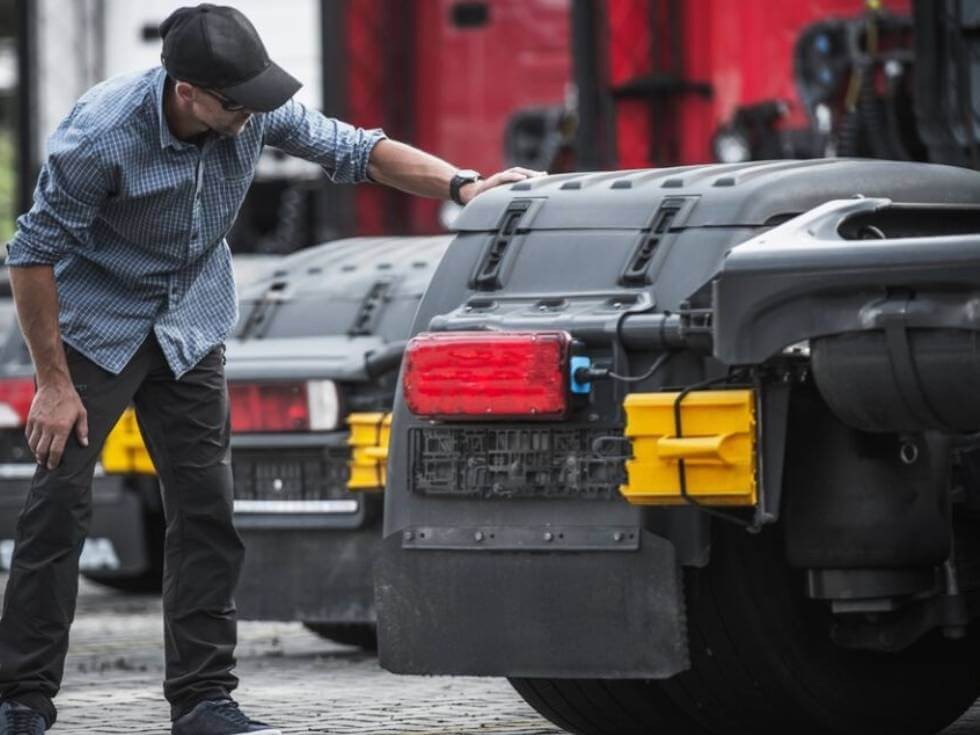
Roadside inspections can occur practically anywhere. With advances in technology and procedures, roadside inspections are no longer limited to being conducted at permanent facilities along our highways and can now be conducted virtually anywhere. The main purpose for these inspections it to give the commercial vehicle and its driver an on-the-spot check-up to keep the driver and others on the road safe.
During 2011 over 70,000 roadside inspections were conducted. Out of these 70,000 vehicle inspections, 18.3% were placed out of service for mechanical problems. The driver out of service rate was 4%. This means that nearly 13,000 vehicles and nearly 3,000 drivers were placed out of service. Once a vehicle or driver has been placed "out-of-service", they are no longer able to continue working until the problem or issue is repaired. Be sure all our vehicles have proper documentation, inspection books and all mechanical repairs are complete.
There are currently 6 levels of roadside inspections:
- Level 1- Examination of drivers documents and detailed vehicle inspection.
- Level 2- Walk-around driver/vehicle inspection. Includes document inspection and inspection of items that can be seen without getting under the vehicle.
- Level 3- Driver only inspection. Involves checking documents and items only related to the driver.
- Level 4- These are special inspections. Example- Checking a vehicles brakes.
- Level 5- This is a vehicle only inspection and is conducted without the driver present.
- Level 6- Inspection for radioactive shipments.
The CSA (Comprehensive Safety Analysis) is an enforcement initiative that scores carriers and drivers on seven Behavior Analysis Safety Improvement Categories (BASIC).
The seven basics are:
- Unsafe Driving: Refers to dangerous or careless operation of commercial motor vehicles.
- Fatigued Driving: Refers to driving a commercial motor vehicle while fatigued.
- Driver Fitness: Refers to drivers who are unfit to operate a Commercial Motor Vehicle due to lack of training, experience, or medical qualification.
- Controlled Substances and Alcohol: Refers to drivers who operate a Commercial Motor vehicle under the influence of drugs and alcohol.
- Vehicle Maintenance: failure due to improper or inadequate maintenance.
- Cargo Related: Shifting loads, spilled or dropped cargo, and unsafe handling of hazardous materials.
- Crash Indicator: Histories or patterns of high crash involvement, including frequency and severity.
For additional information on this topic visit http://bit.ly/M0j9wb
Posted by
Katie Ross on Tue, May 08, 2012 @ 08:23 AM
We recently announced that Tracey Road Equipment has joined the Elite Support Family of Dealers-- now there is more exciting news! We will be holding an Elite Support Dealer Open House here at Tracey Road Equipment in East Syracuse on Thursday July 26th from 10-4pm! Come see first hand what an Elite Support Dealer looks like, and all of the amazing additions we have made to our facility to better serve our customers.
click here to download and print your own save the date!

Want to learn more about the Elite Support Dealer program? Check out our blog all about it!
Asphalt paving is a complex operation and attention to detail is critical. Constant alertness, and attention to the conditions of the jobsite and fellow workers is very important. It is important that all ground workers are well trained for his/her assigned job, familiar with the crew's particular routine and are well educated about the hazards of asphalt fumes.
Paving Jobs are very busy and safety is a must. There is always a steady flow of trucks delivering hot asphalt to the paver. DO NOT move between the paving machine and the backing trucks. The paver operator has many things going on and the truck driver cannot see this area. Make sure to always stand clear of the pavers hopper when the trucks are transferring the hot asphalt to the paver. Always make sure that the delivery trucks have adequate side and overhead clearance of any obstacles including utility lines and overpasses.
Here are some additional tips to keep in mind:
- Watch for any machine malfunctions. If any malfunctions are detected, shut the machine down and correct them immediately.
- Keep all personnel clear of the pavers auger at all times and make sure all auger and screed extension guards are installed properly.
- Be observant to other machines on the job including, rollers, sweepers, water trucks, etc.
- Know and obey all flaggers and ground personnel and understand signs and signals.
- Never remove material from the auger or hopper while the machine is running.
- Never jump on or off the machine.
- Paver operator- Stay in the operator seat at all times.
- Always wear proper safety equipment.
- Report any unsafe conditions to the supervisors immediately.
Things happen fast on paving jobs. Always stay alert and have the ability to react quickly to in any emergency. Be sure that all employees are trained in first-aid procedures. Tracey Road Equipment hopes you have a safe and prosperous paving season.

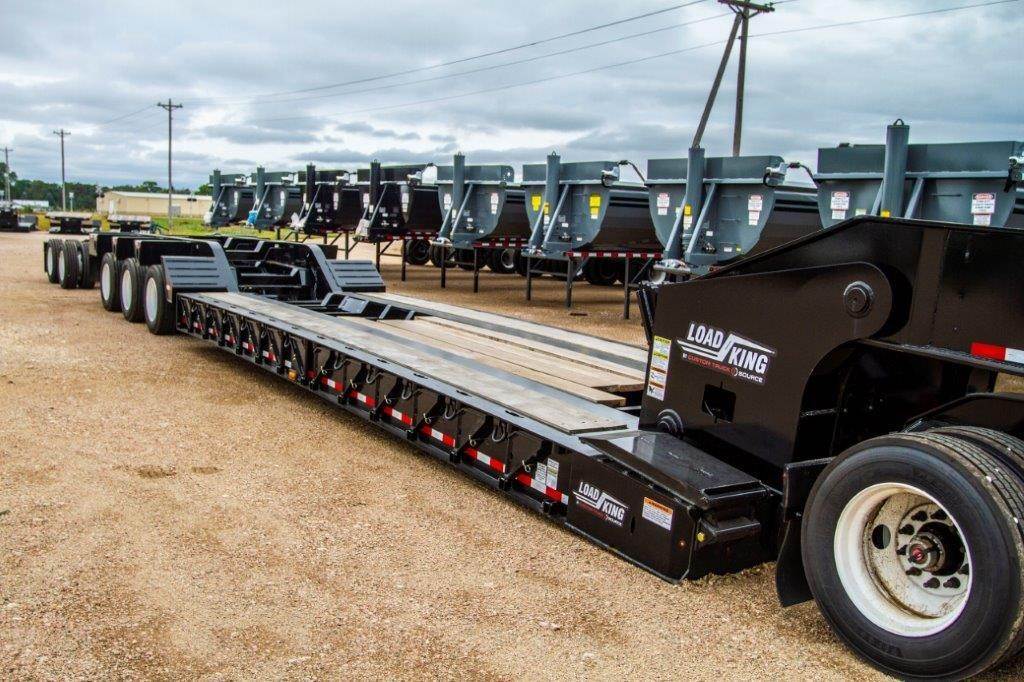
Most of todays heavy hauling accidents are attributed to human error rather than mechanical failure. Proper hauling requires a combination of knowledge, training, experience and patience. Before hauling a piece of equipment you must know your trailers limits and your trucks capabilities. You can usually find the trailer's capacity on the data plate mounted on the trailer. Know your limits!
It is crucial to know how and where to position the load on the trailer. The machine weight must be evenly distributed throughout the vehicle and trailer. If the machine is placed too far forward, you will start to lift the front of the tow vehicle and lose steering control. If the machine is placed too far back, you will lose traction and braking. Be aware that the added weight of the machine will increase your stopping distance. Finding the right placement takes time and patience. It is important to keep in mind that all machines are different and not all machines are loaded the same. Wheel loaders, skid steers, excavators and dozers all have their own loading/unloading procedures.
Here are some helpful tips:
- Know proper loading/unloading procedures for the machine you are hauling.
- Always load/unload on level ground.
- Make sure ramps and trailer deck are in good working order. Replace any worn or broken boards.
- Make sure trailer ramps and trailer deck are clean and clear.
- Keep others clear while loading/unloading.
- Do not drive a machine on a trailer unless you are trained to do so.
The next important thing is keeping your load secure. Most trailers are equipped with tie-down points. Using the weight of the machine, you will be able to determine the aggregate working load limit to determine the number of tie-downs you will need. Many manufacturers mark the tie-down points on the machines and it is important to use these points. You should always use grade 70 chain or greater for securing your loads. Make sure to discard and worn, stretched or twisted chains.
Additional Tips:
- Secure all loose attachments.
- Once loaded make sure to check your overall height.
- Always do a final walk-around to make sure there is nothing you missed.
- Loads shift.....Always stop after the first 25 miles and check your tie-down points.
Following these guidelines will help to keep you and others safe on the road. Hauling is a big job, but with a little patience and practice, it can be done safely.

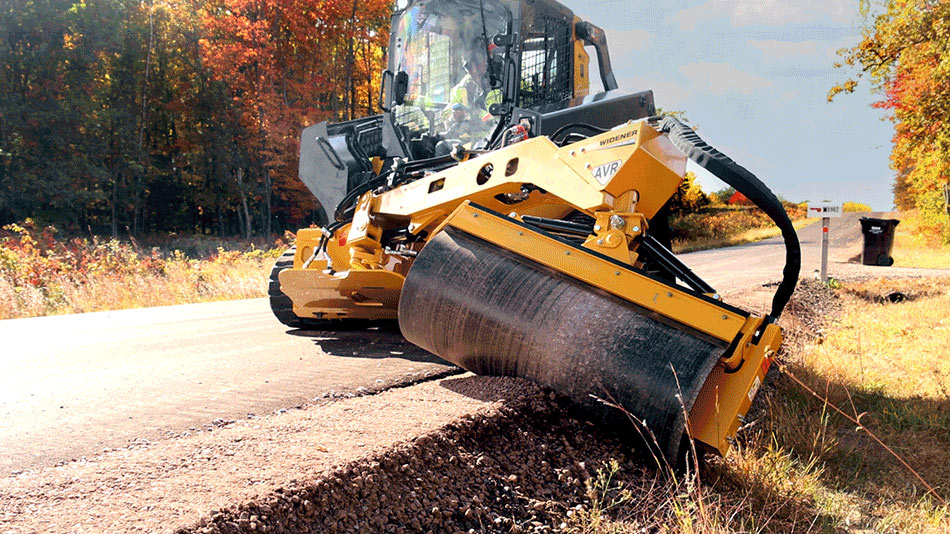
A skid steer is a very versatile machine and can be used to complete a variety of different jobs. Whether you are a farmer, landscaper, or municipality, skid steers can offer the support you need in a compact unit. Skid steers can be adapted with a long list of attachments including buckets, forks, brooms, asphalt planers, mowers, trenchers, and the list goes on. This is what makes a skid steer the machine of choice for many different situations.
While these are very versatile machines, caution must be used while operating them. Always do a thorough inspection of the skid steer prior to using it, you never know who used it last and how they left it. Inspect the machine for any damage and ALWAYS make sure attachments are securely locked on the machine.
Here are a few additional tips to help keep you safe:
- Always plan your work. Know your jobsite and the obstacles that are around you. Know what material you will be moving and where it will be moved to. Always operate at a safe controlled speed and make sure to carry your load low (if using a bucket).
- Use caution on slippery terrain. Always raise and lower the bucket at a even steady rate and be ready to lower the load quickly if the skid steer is in an unstable situation.
- Do not drive across slopes. Always travel straight up and down on slopes.
- Know your center of gravity. The center of gravity on a skid steer changes when you raise and lower loads. Never travel too fast of make sharp turns with a raised load. Never overload the machine.
- Proper shutdown. Never leave the machine while your boom is in the air. Always make sure loader arms are lowered and your attachment is on the ground before exiting the machine.
Skid steers are a great machine, but like many machines, following safety procedures greatly improves the safety of you and your crew.
Posted by
Katie Ross on Tue, Apr 17, 2012 @ 03:23 PM
Spring has sprung, and summer is fast approaching which means more construction zones are going to be popping up all over. The U.S. Department of Transportation and the Federal Highway Administration present National Work Zone Awareness Week each spring, to highlight the dangers of work zones as well as motorist and worker safety. April 23-27 of this year is that week, the DOT will place work zone safety ribbon magnets on all DOT vehicles and run print, radio and outdoor ads in New York City as well as Albany to promote it.
On average, around 600 work zone fatalities occur in the U.S. every year, and over four out of five work zone fatalities are motorists. The statistics go on and on, it’s simply astonishing. Some simple safety tips that everyone can follow to try and avoid any work zone accidents are to drive within the posted speed limits, dedicate full attention to the roadway, pay close attention to merge signs and be patient. New York State's Department of Transportation's Operation Hard Hat highlights ten safety tips that we all can, and should keep in mind this season.
A Work Zone Safety Bill is in front of the New York State Legislature, and would make tougher penalties for drivers that cause death or injury within a work zone. Intrusion into an active work zone would be considered a class B misdemeanor and result in a $250 to $500 fine, and a maximum sentence of three months in prison. Other parts of the bill include penalties for vehicular manslaughter in an active work zone in the first and second degree, as well as vehicular assault in an active work zone in the first and second.
In Michigan a person who is caught speeding more than 10 miles over the posted speed limit in a work zone and as a result causes death to a person working in a construction zone is guilty of a felony punishable by a fine of not more than $7,500 or by imprisonment of not more than 15 years or both. Being a careless driver within a work zone, can result in the felony penalties, it is no longer reserved for reckless or drunken drivers.
The danger does not come only from the drivers outside the work zone, but also from the construction vehicles within it. Equipment World's February 2008 edition of "Safety Watch" is entitled Hazards of the Road, and addresses both sides of the risks a construction worker must be mindful of. Any given site could be filled with things like dump trucks, graders, compactors and pavers, and a worker must be aware of those things as well as the outside traffic simultaneously.
So when you're traveling this spring and summer, be prepared for work zones by reviewing safety tips, being fully aware of your surroundings, and when you see those orange reflective barrels, slow down. These frequent spots along your commute may seem like a nuisance, but keep in mind that workers are putting themselves at risk to repair the highways and bridges that we all drive on, making it safer for us -- Let's make it safer for them.

That's right.....our tax dollars are at work for china. A story recently done by ABC News reports that Obama has approved for U.S. bridge projects to be constructed by Chinese contractors. This information has been a blow to American citizens who are unable to find work in the United States. Supporters claim that there is a shortage of skilled American welders and this has become a large issue for American contracting firms. Bridge jobs have already been awarded to the Chinese in New York, California and there are more on the way. Obama has promised new jobs in the U.S. by improving our infrastructure, but it seems our tax dollars are at work for China. Many worry that more and more jobs will continue to be outsourced to other countries.
WATCH THE VIDEO
These bridge projects are large jobs and could provide thousands of jobs for U.S. workers. Our infrastructure is crumbling before our eyes and something needs to be done about it, and this is the perfect opportunity to create new jobs for Americans right here on American soil. This is not the time to send more jobs to other countries. Our tax dollars will provide thousands of jobs right here at home.
Posted by
Katie Ross on Fri, Apr 13, 2012 @ 12:57 PM
It is a widely understood notion that fashion and comfort, or safety do not go hand in hand. Women suffer all kinds of things in the name of fashion, the killer foot pain from designer heels, eyebrow waxing and more. Surprisingly enough the Compliance Magazine award winning company Gateway Safety has combined comfort and safety with a touch of fashion for all of the ladies out there.
The StarLite, StarLite Gumballs and Scorpion lines of protective eyewear have also been produced 10% smaller in SM sizing for those with narrow faces or smaller profiles. The Metro line features a more attractive style resembling sunglasses more than safety gear, while weighing less than an ounce. What’s more the Metro line comes in variations of pink and tortoise shell as well as the classic caramel and black colors for those with a style preference, and the a soft nosepiece and contoured temple tips provide added comfort!
If all of that wasn’t impressive enough there is the Serpent Ventilated Safety Helmet. The snake-head shell design provides more visual interest than the standard hard hat, and it is also lightweight at 13.1 ounces. While maintaining the many safety compliance points the Serpent has the option for pin-lock or ratchet suspension adjustment allowing it to contour to smaller heads. Once again for those color conscious customers this item is available in pink, blue, green, orange, yellow, red, white, and even high visibility shades.
From safety glasses to helmets, products have been redesigned with women in mind. As a fashion forward female I am very excited and happy to see that in a seemingly masculine industry women are making their mark and being considered while designing safety and protection gear.

New York State's Infrastructure Is Crumbling rapidly and continues to put our families and our economy at risk. Highways, roads and bridges across New York State continue to deteriorate and the longer we wait to address this problem, the more expensive the repair will be. A recent analysis of New York State's transportation system found that it will take $175 Billion over the next 20 years to maintain out transit system. This study also found that an additional $75 billion is needed to repair and maintain out underground sewer and water system, ensuring clean drinking water for our families for years to come. These investments will support more than 60,000 construction jobs in regions across New York State and keep the economy moving.
During Governor Cuomo's 2012 state of the state address, he cited the following statistics:
- 32% Of New York State's bridges are rated deficient.
- 40% Of New York States roads are rated fair to poor and are getting worse each year.
- 83% Of New York State Parks and DEC's major dams are in poor condition.
What Can Be Done?