

Service Hours
Syracuse:
- Monday - Friday: 7:00AM - 11:00PM
- Saturday: 7:00AM - 12:00PM
- Sunday: Closed
Other Locations:
- Monday - Friday: 7:00AM - 5:00PM
- Saturday - Sunday: Closed
Elite Support Locations
Other Locations
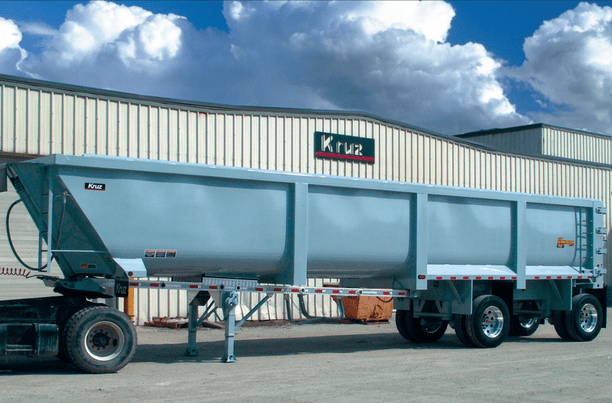
Tracey Road Equipment is expanding our trailer lineup with a new name built around heavy-duty hauling: Kruz-Ravens Trailers.
We are now a dealer for the complete Kruz and Ravens product line, adding steel and aluminum dump trailers, dump bodies, flatbeds, and other specialized hauling solutions to the products available through Tracey Road. While the complete lineup offers plenty to explore, we’re starting with one of the manufacturer’s core product categories: dump trailers.
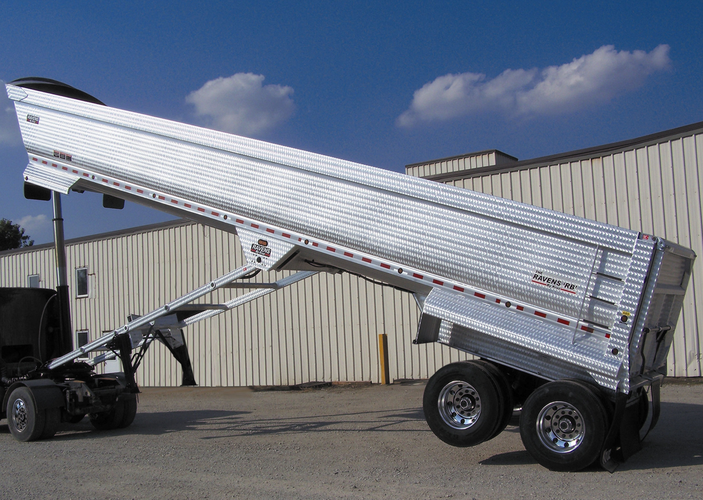
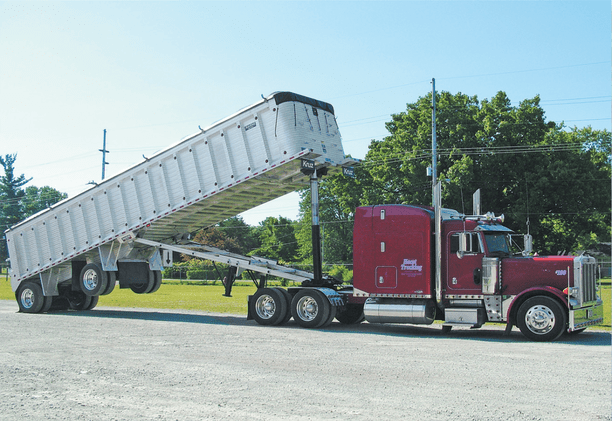
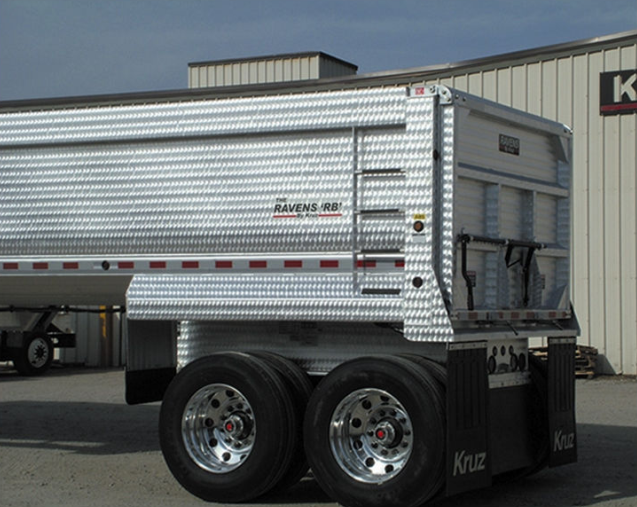
Kruz Inc. brings together two distinct product lines. Kruz represents the company’s steel trailers, while Ravens is its aluminum line, recognizable by its distinctive swirl-finished aluminum construction.
For contractors, aggregate haulers, paving companies, municipalities, and other fleets moving bulk materials, that gives customers the ability to choose a dump trailer based on the material they haul, payload priorities, operating conditions, and the type of work they perform.
Here’s a closer look at Kruz-Ravens Trailers and some of the dump trailer options now available through Tracey Road Equipment.
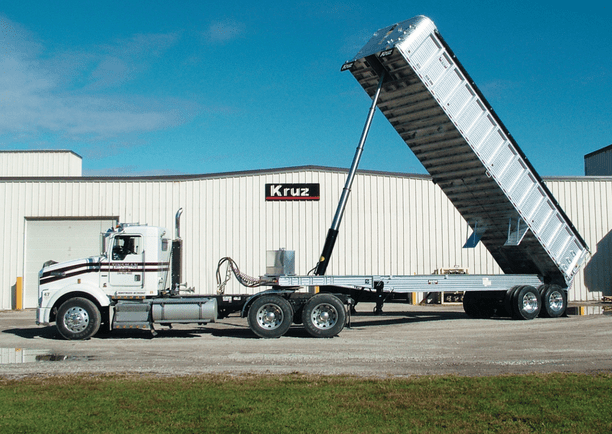
Kruz Inc. manufactures quality semi dump trailers, flatbed trailers, and dump bodies. The steel line of these products is branded under the name of Kruz and the aluminum line uses the brand Ravens®. The Ravens® line features a distinctive swirl finish. Founded in 2003, Kruz® is backed by decades of experience and has a reputation for quality and service.
The Ravens® line features a distinctive swirl finish. Founded in 2003, Kruz® is backed by decades of experience and has a reputation for quality and service.
Although Kruz Inc. was established in its current form in 2003, the company’s roots in trailer manufacturing stretch back considerably further. Its history includes Bobko, Galbreath, and Ravens, with experience building steel and aluminum trailers for demanding hauling applications.
Today, that history comes together under two familiar names.
Kruz is used for the company’s steel product line, including its well-known Terminator dump trailers.
Ravens represents the aluminum side of the lineup, offering several dump trailer designs built from high-strength aluminum alloys.
Together, the two brands give customers a broad selection of dump trailer configurations instead of taking a one-size-fits-all approach.
One of the first decisions when selecting a dump trailer is whether steel or aluminum makes more sense for the work being performed.
Neither material is automatically the right choice for every fleet.
Steel dump trailers are often selected for demanding applications where durability and resistance to impact are major considerations. Operations regularly hauling heavier or more abrasive materials may prioritize the rugged construction of a steel trailer.
Aluminum dump trailers approach the job differently. Aluminum construction can reduce empty trailer weight, which can help maximize legal payload depending on the trailer configuration, tractor, axle setup, and applicable weight regulations.
Corrosion resistance can also make aluminum attractive for fleets working in environments where moisture and road treatments are common.
Kruz-Ravens Trailers offer options on both sides, allowing customers to evaluate the trailer around the work rather than being limited to a single construction material.
One of the best-known names in the Kruz lineup is the Kruz Terminator.
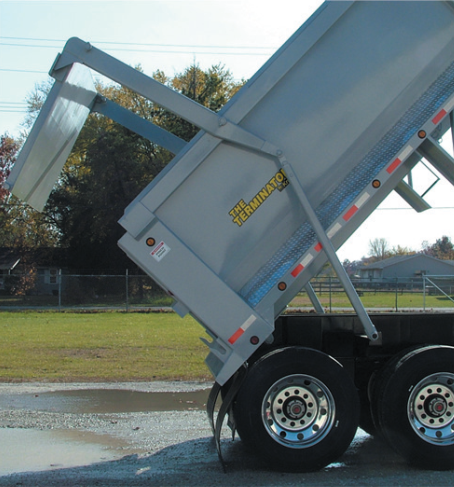
The Terminator has been part of the product family since 1993 and is designed as a heavy-duty steel dump trailer for demanding hauling applications.
Its body uses HARDOX steel with rounded sides and a flat floor. HARDOX steel combines high strength and impact resistance while allowing Kruz to build the trailer around demanding material-hauling applications.
The interior bulkhead is sloped to help material flow during unloading.
Another advantage is configuration flexibility. Kruz offers the Terminator in frame, frameless, and semi-frameless designs, giving fleets multiple ways to configure the trailer around their hauling needs.
Depending on the application, customers can also select from different trailer lengths, suspension configurations, axles, wheels, tailgates, and other equipment.
For fleets hauling materials where rugged steel construction is a priority, the Terminator is an important part of the Kruz dump trailer family.
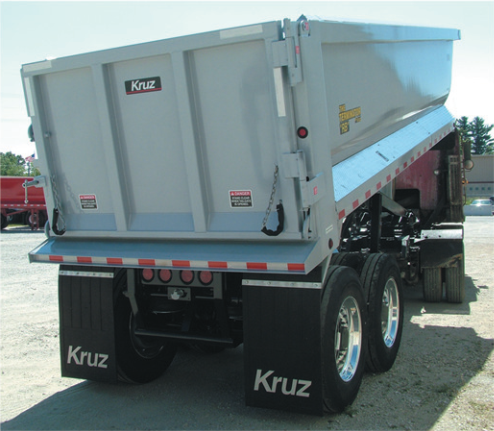
The Kruz Terminator RB builds on the Terminator name with a round-bottom body design.
Round-bottom dump trailers can be particularly useful when material flow is an important consideration. The curved interior reduces corners where material can collect and creates a different unloading profile than a traditional square or flat-sided body.
The RB gives customers another steel option when matching a Kruz trailer to the material being hauled and the unloading characteristics they want.
For fleets considering steel construction, the ability to compare traditional Terminator configurations with the Terminator RB helps narrow the trailer around the actual application rather than simply choosing based on capacity.
On the aluminum side of the family, Ravens offers several different approaches to dump trailer design.
These trailers are constructed from high-strength aluminum alloys and feature the recognizable Ravens swirl finish.
The main advantage of the Ravens lineup is the ability to combine heavy-duty construction with a relatively low empty trailer weight. Reducing trailer weight can potentially leave more capacity available for payload while staying within applicable weight limits.
Ravens also gives customers choices between frame-type, frameless, round-bottom, and double-wall configurations.
That variety is important because a trailer hauling aggregate every day may have different requirements than one hauling lighter bulk materials or working in applications where maximum cubic-yard capacity is the priority.
The Ravens Frame Type combines a conventional frame-style dump trailer with high-strength aluminum construction.
Available configurations include trailer lengths from approximately 18′ to 45′ feet, side heights from 36″ to 108″ inches, and widths of either 96 or 102 inches.
Depending on configuration, capacities range from approximately 28.4 to 60.6 cubic yards.
Customers can also choose between a standard or heavy-duty aluminum chassis or a steel chassis, providing additional flexibility depending on the work.
Heavy-duty hoist components, rigid sides, and substantial top rails are incorporated into the design to help the trailer handle demanding dump applications.
For customers who prefer the characteristics of a frame-type trailer but want the payload advantages associated with aluminum construction, the Ravens Frame Type provides a strong option.
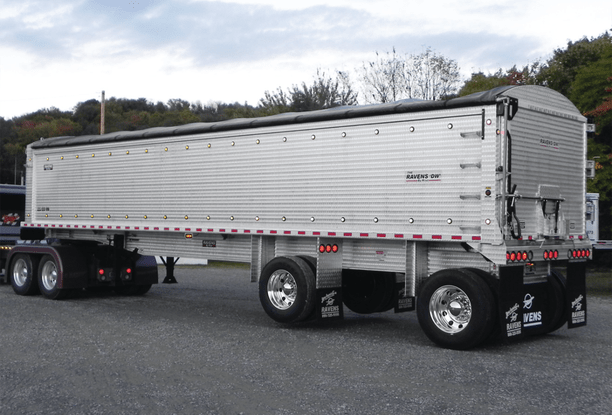
The Ravens Frameless takes a different approach.
By eliminating the traditional full-length trailer frame, the design helps control empty weight while retaining the capacity needed for bulk hauling.
Ravens offers its frameless aluminum dump trailers in lengths ranging from approximately 24′ to 45′ feet, with side heights between 36″ and 108″ inches and widths of either 96 or 102 inches.
Available capacities range from approximately 28.4 to 60.6 cubic yards, while published trailer weights range from roughly 9,520 to 12,760 pounds, depending on configuration.
Heavy-duty top rails and reinforced sides are incorporated into the body structure.
For fleets focused heavily on maximizing payload, the combination of aluminum construction and a frameless design makes this one of the most notable options within the Kruz-Ravens Trailers lineup.
Customers looking for a round-bottom trailer without moving to steel can consider the Ravens RB.
The Ravens RB is constructed from high-strength aluminum alloys and uses a round-bottom design intended to provide heavy-duty performance without unnecessary bulk.
The body incorporates 5083 aluminum plate in key areas along with 6061-T6 extruded aluminum components. Its construction includes a heavy-duty rear floor sill, reinforced sides, substantial top rails, and body saddles.
Like other Ravens products, the RB provides an alternative for fleets looking to balance trailer durability with payload capacity.
The round-bottom design also gives customers another choice based on the types of material they regularly haul and how they want that material to flow during unloading.
Another option is the Ravens Double Wall, or DW.
This aluminum dump trailer uses a double-wall body design built around high-strength aluminum alloys. Its construction includes an aluminum plate floor, extruded aluminum hollow-panel sides, heavy-duty top and bottom rail profiles, and reinforced rear components.
Available options include features such as a two-way tailgate, ground controls, and coal-door configurations.
The Double Wall gives fleets another way to balance strength, body design, and weight, particularly for applications where operators want the characteristics of an aluminum trailer combined with a reinforced body structure.
With this many configurations available, choosing between Kruz and Ravens isn’t simply a matter of asking whether steel or aluminum is better.
The better question is: What does the trailer need to do every day?
Start with the material.
A fleet hauling demanding, abrasive material may have different durability requirements than a fleet focused primarily on lighter bulk materials. Material density also matters because a trailer can reach its legal weight limit long before it reaches its full cubic-yard volume.
Payload is another major consideration. Reducing empty trailer weight may allow certain fleets to carry more material per trip, making an aluminum Ravens trailer worth considering.
Then there is unloading. Frame versus frameless construction and traditional versus round-bottom body designs can influence how the trailer behaves during dumping and how material moves out of the body.
Trailer length, side height, axle configuration, suspension, tailgate design, and available options should all be considered as part of the complete setup.
The goal isn’t simply to buy the largest trailer available. It’s to configure a trailer around the material, tractor, routes, jobsite conditions, and hauling requirements of the fleet.
Adding Kruz-Ravens Trailers expands the range of hauling solutions available to Tracey Road customers.
It also gives customers more choices when comparing steel and aluminum dump trailers.
For customers prioritizing rugged steel construction, the Kruz lineup provides options such as the Terminator and Terminator RB. For operations focused on aluminum construction and payload, Ravens offers Frame Type, Frameless, RB, and Double Wall designs.
And because Tracey Road carries the complete Kruz-Ravens product line, our team can also help customers explore the manufacturer’s other products when a dump trailer isn’t the only equipment their fleet needs.
Choosing the right dump trailer can have a significant effect on payload, productivity, durability, and day-to-day operating costs.
That’s why having choices matters.
The addition of Kruz-Ravens Trailers gives Tracey Road Equipment customers access to both steel and aluminum dump trailer options, along with multiple body and frame configurations designed around different hauling applications.
Whether you’re comparing a rugged Kruz Terminator, looking to maximize payload with a Ravens aluminum trailer, or simply trying to determine which configuration best fits the materials your fleet moves every day, our team can help you evaluate the options.
Service Hours
Syracuse:
Other Locations:
Elite Support Locations
Other Locations