
Hyundai Excavator Engines: The Power Behind the Next Generation
Hyundai Construction Equipment’s Next Generation excavators bring major changes to the jobsite, from advanced hydraulic controls and increased productivity to longer service intervals and new operator-assistance technology. But some of the most important changes are happening behind the scenes.
At the center of Hyundai’s Next Generation machines are the new DX05 and DX08 Hyundai Excavator Engines.
Rather than selecting an existing engine and designing the excavator around it, Hyundai developed these engines alongside the machines they power. The engine, hydraulic system, cooling package, and electronic controls were engineered to work together as one integrated system.
The goal is simple: provide the power contractors need while improving fuel efficiency, machine response, serviceability, and overall owning and operating costs.
As a Hyundai Construction Equipment dealer, Tracey Road Equipment is excited to see the Next Generation excavator lineup continue to grow. Here’s a closer look at the DX05 and DX08 engines and why they are an important part of Hyundai’s new approach to excavator design.
Inside the Engines Powering Hyundai's Next Generation Excavators
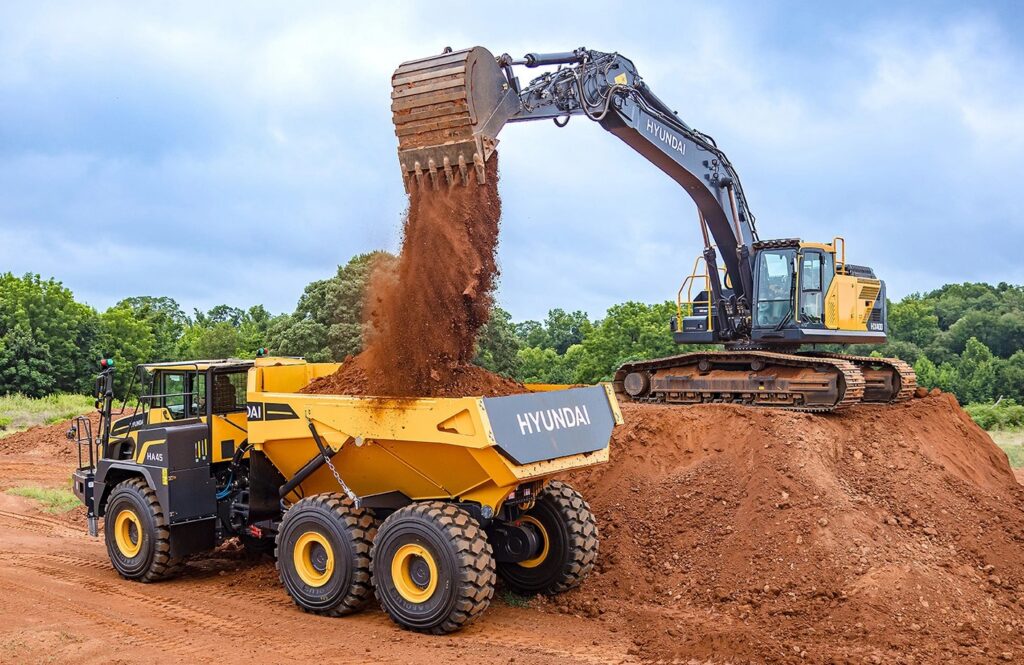
Hyundai DX05 and DX08 diesel engines power select Hyundai Next Generation excavators, bringing engine performance, hydraulics, and electronic controls together as one integrated system. Designed specifically for HD Construction Equipment, these engines help optimize machine performance, improve fuel efficiency and lower total owning and operating costs.
Why Did Hyundai Develop Its Own Excavator Engines?
An excavator is a collection of systems that constantly interact with one another. The engine produces power, but the hydraulic system determines how that power reaches the boom, arm, bucket, swing system, and travel motors. Electronic controls increasingly determine how quickly and efficiently everything responds.
If these components aren’t optimized to work together, some of the machine’s potential can be lost.
That’s why Hyundai took a different approach with the DX05 and DX08.
The engines were developed specifically for Hyundai’s Next Generation construction equipment. Hyundai engineered the engines alongside the hydraulic system, cooling package, and electronic controls, allowing the complete powertrain to function as an integrated system.
That gives Hyundai greater control over how the excavator responds under different loads and operating conditions.
For customers, the result is intended to provide smoother operation, responsive hydraulics, improved efficiency, and lower total owning and operating costs.
Meet the Hyundai DX05 and DX08 Engines
The new engine family consists of two primary platforms: the DX05 and DX08.
Both are turbocharged diesel engines that meet EPA Tier 4 Final and Stage V emissions requirements, but their size and output allow Hyundai to use them across different excavator classes.
Hyundai Engine Specifications
| Specification | DX05 | DX08 |
|---|---|---|
| Configuration | Inline 4-cylinder | Inline 6-cylinder |
| Displacement | 5.0 L | 7.5 L |
| Maximum Engine Output* | 230 hp @ 2,200 rpm | 341 hp @ 2,200 rpm |
| Maximum Torque | 704 lb.-ft. @ 1,400 rpm | 1,077 lb.-ft. @ 1,300 rpm |
| Emissions | Tier 4 Final / Stage V | Tier 4 Final / Stage V |
*These figures represent the maximum industrial ratings of the DX05 and DX08 engine platforms. Actual horsepower ratings vary depending on the excavator model and application.
The DX05 provides a compact four-cylinder solution for Hyundai’s smaller Next Generation excavators, while the larger six-cylinder DX08 provides the additional output required by larger machines.
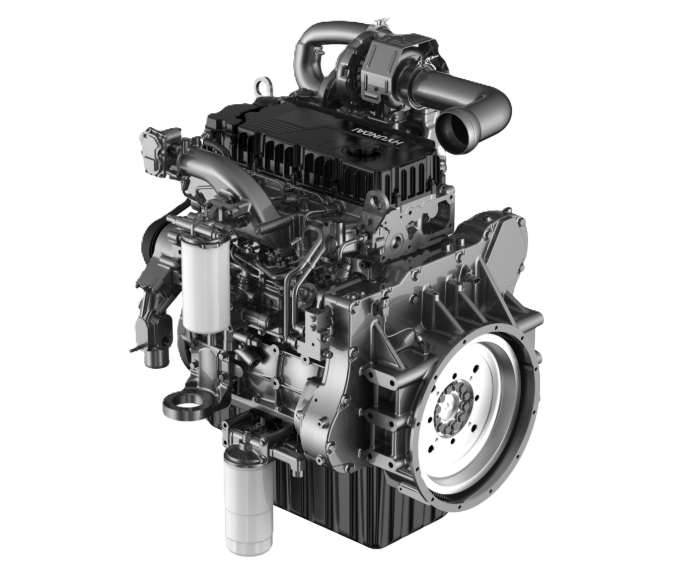
The DX05: Compact Power for Mid-Size Excavators
The DX05 is a 5.0-liter inline four-cylinder engine capable of producing up to 230 horsepower in its industrial configuration and maximum torque of 704 lb.-ft. at 1,400 rpm.
Its relatively compact design allows Hyundai to provide significant output without requiring the physical size of a larger six-cylinder engine.
In the Next Generation excavator lineup, the DX05 is used in machines including the HX210L and HX230L.
For example, the HX210L uses a DX05 rated at 186 net horsepower. Hyundai says the engine provides 6% more torque and contributes to a 7% improvement in fuel efficiency compared with the previous machine, while DEF consumption is reduced by 30%.
The DX05 demonstrates an important point about engine specifications: maximum engine capability and actual machine ratings are not necessarily the same thing.
Hyundai can calibrate the same engine platform to match the hydraulic requirements, operating weight, and performance targets of a specific excavator. The objective isn’t simply to produce the highest horsepower number possible. It’s to provide the appropriate power for the complete machine.
The DX08: Power for Larger Next Generation Excavators
Moving up the lineup brings us to the DX08.
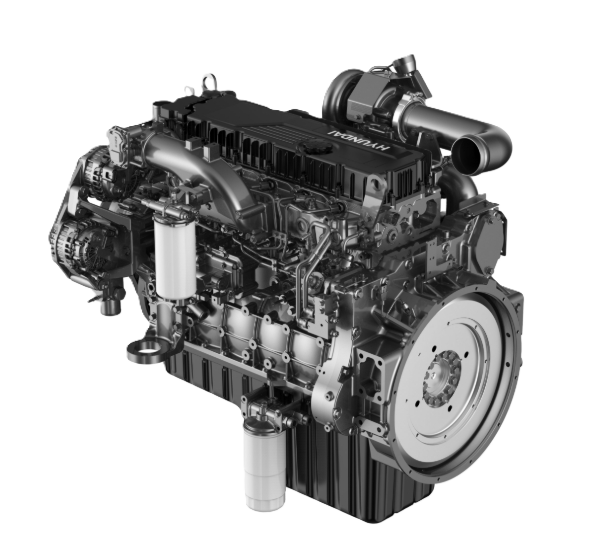
This 7.5-liter inline six-cylinder engine provides maximum industrial output of 341 horsepower at 2,200 rpm and maximum torque of 1,077 lb.-ft. at 1,300 rpm.
The DX08 provides the foundation for several of Hyundai’s larger Next Generation excavators.
For example, the HX300L uses the DX08 with a net machine rating of 277 horsepower, while the HX360L produces 300 net horsepower. At the top of the current Next Generation group, the HX400L uses the DX08 to produce 336 net horsepower.
Using the same basic engine architecture across multiple excavator sizes allows Hyundai to tailor performance to each machine while maintaining commonality within the engine family.
Designed as Part of the Complete Machine
One of the most important differences between the DX engine strategy and a traditional engine installation is integration.
Hyundai describes the DX05 and DX08 as being engineered specifically for its Next Generation excavators rather than adapted from an unrelated application.
That means the engine isn’t operating independently from the rest of the machine.
The engine, hydraulics, cooling package, and electronic controls are designed to communicate with one another. When the operator requests hydraulic power, the machine can coordinate those systems to provide the response required while managing engine output and fuel consumption.
This becomes even more important as excavators incorporate increasingly sophisticated electronic hydraulic controls.
The Next Generation HX excavators use Hyundai’s Fully Electro-Hydraulic, or FEH, system. Hyundai says the combination of its new engines and FEH technology contributes to productivity improvements of at least 22% across the first five Next Generation machines, while the new engines are nearly 10% more fuel efficient.
For contractors, the important number isn’t simply horsepower. It’s how effectively the entire excavator turns that horsepower into productive work.
More Productivity Without Simply Burning More Fuel
Increasing productivity doesn’t necessarily mean increasing engine speed or fuel consumption.
Hyundai designed the DX05 and DX08 around intelligent engine management and refined power delivery so the excavator can provide power when the operator needs it without wasting fuel when it doesn’t.
That integration works alongside the machine’s hydraulic system to improve response and breakout performance.
For an excavator that may spend an entire shift digging, loading trucks, trenching, or moving material, small efficiency improvements can become significant over hundreds or thousands of operating hours.
Fuel is one of the most visible operating expenses for heavy equipment owners. Improving the amount of productive work completed for each gallon consumed can directly affect the machine’s lifetime operating cost.
1,000-Hour Oil Change Intervals
The benefits of the new Hyundai Excavator Engines aren’t limited to performance.
Hyundai has also extended engine oil change intervals to 1,000 hours.
Longer service intervals mean fewer scheduled stops throughout the machine’s operating life. For fleet owners, that can reduce maintenance labor, consumable costs, and the amount of time equipment spends out of production for routine service.
Consider a machine accumulating 2,000 hours in a year. Increasing the interval between scheduled engine oil services can eliminate several maintenance events compared with shorter traditional intervals.
Of course, actual maintenance should always follow Hyundai’s recommendations for the specific machine, application, operating conditions, and fluids being used.
The broader goal is to keep the excavator working longer between scheduled maintenance stops.
Designed to Reduce Repair Costs
Another major focus of the DX05 and DX08 program is what happens after the machine leaves the dealership.
An engine isn’t inexpensive to repair, and parts availability and component pricing can have a significant impact on total cost of ownership.
Hyundai says genuine repair parts for the DX05 and DX08 can cost up to 50% less than previous premium competitive engine brands.
The engines were also designed with simplified maintenance in mind.
That combination can provide several potential advantages for equipment owners:
Competitive replacement-parts pricing
Genuine Hyundai engine components
Simplified maintenance
Fewer scheduled service interruptions
Lower lifetime owning and operating costs
These costs may not attract as much attention as horsepower when comparing excavators, but they can become extremely important after several thousand hours of ownership.
One Source for Machine and Engine Support
Bringing engine development within the Hyundai equipment ecosystem also simplifies another part of ownership: support.
Instead of having one manufacturer responsible for the excavator and another company responsible for the engine, Hyundai can provide support for the complete machine through its dealer network.
Hyundai has nearly 200 authorized dealer locations across North America supporting its equipment.
That gives customers access to genuine Hyundai engine components and factory-trained technicians while creating a more centralized support structure for the excavator and its powertrain.
For fleet managers, reducing the number of different suppliers involved in maintaining a machine can simplify parts sourcing, troubleshooting, warranty questions, and long-term service planning.
A 5-Year / 3,000-Hour Limited Engine Warranty
Hyundai is also backing the DX05 and DX08 engines with a 5-year / 3,000-hour limited warranty.
For contractors investing in a new generation of equipment and engine technology, that warranty provides additional protection during the early years of ownership.
More importantly, it reinforces Hyundai’s strategy of treating the engine and excavator as parts of one complete equipment platform.
Customers aren’t simply purchasing an excavator that happens to contain an engine. They’re purchasing a machine where Hyundai has taken responsibility for the relationship between the engine, hydraulics, electronics, and other major systems.
How the Engines Fit Into Hyundai's Next Generation Excavators
Hyundai initially introduced five Next Generation HX excavators at CONEXPO-CON/AGG: the HX230, HX260, HX300, HX360, and HX400. The company subsequently expanded the family with the HX210L.
The lineup currently spans from approximately 186 to 336 net horsepower, allowing the DX05 and DX08 platforms to cover a substantial range of excavator applications.
Smaller machines use the compact DX05 architecture, while larger models move to the DX08.
This approach gives Hyundai an engine family that can grow alongside its Next Generation excavator lineup while allowing each machine to receive a power rating appropriate for its size and intended applications.
And because the engines were developed alongside Hyundai’s hydraulic and electronic systems, future machine development can continue around that integrated architecture.
More Than a New Engine
It’s easy to look at the DX05 and DX08 as simply replacements for the engines used in previous Hyundai excavators.
The bigger story is what they represent.
Hyundai’s Next Generation excavators are increasingly being developed as complete systems. Engine management, electro-hydraulic controls, operator inputs, machine-assistance technology, service monitoring, and other systems are becoming more closely connected.
The DX05 and DX08 provide the power foundation for that strategy.
Rather than asking only, “How much horsepower does this excavator have?” customers may increasingly need to consider questions like:
- How efficiently does the machine use that power?
- How well does the engine communicate with the hydraulic system?
- How frequently does the engine require maintenance?
- What will replacement parts cost?
- Who supports the engine?
How does the powertrain contribute to overall productivity?
Those factors provide a much better picture of the real value of an excavator over its working life.

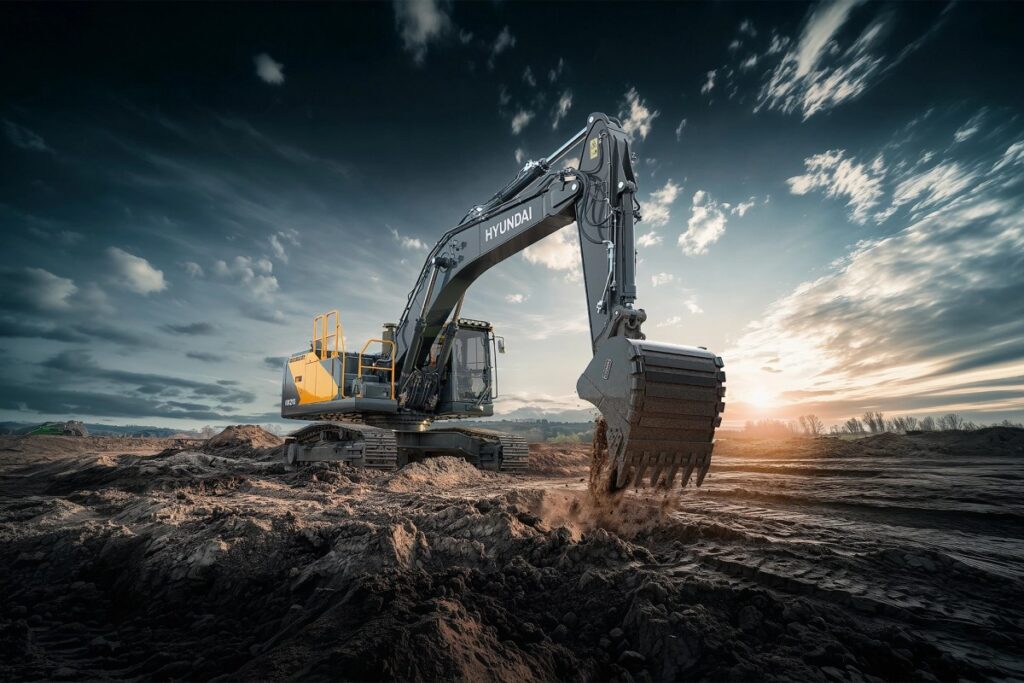
Hyundai Excavator Engines at Tracey Road Equipment
The DX05 and DX08 represent an important step in the evolution of Hyundai Construction Equipment.
By developing its own engine platform alongside the hydraulics, cooling system, and electronic controls of its Next Generation excavators, Hyundai has taken a more integrated approach to performance.
The result is designed to provide contractors with responsive power, improved fuel efficiency, longer maintenance intervals, competitive repair costs, and centralized Hyundai support.
As a Hyundai Construction Equipment dealer, Tracey Road Equipment is excited to support the growing Next Generation excavator lineup and the new technology behind it.
Whether you’re comparing excavator models, evaluating operating costs, or simply interested in what’s changing beneath the hood of Hyundai’s latest equipment, our team can help you better understand the DX05 and DX08 and how they fit into the Next Generation lineup.

Service Hours
Syracuse:
- Monday - Friday: 7:00AM - 11:00PM
- Saturday: 7:00AM - 12:00PM
- Sunday: Closed
Other Locations:
- Monday - Friday: 7:00AM - 5:00PM
- Saturday - Sunday: Closed
Elite Support Locations
Other Locations